Get Help Today! | 978.474.8670

Micromobility has taken over Massachusetts streets. Bluebikes stations sit on hundreds of corners across metro Boston, rental scooters line the sidewalks, and privately owned e-bikes and e-scooters are now part of everyday traffic. These devices are fast, affordable, and convenient. They are also exposed. A rider has little protection and shares the road with cars, buses, and trucks that are far larger and faster.
When a crash happens, the legal questions are harder than they are after an ordinary car accident. E-bikes and e-scooters fall into a patchwork of Massachusetts rules, and in most cases there is no auto insurance policy attached to the device itself. Who pays, and what is covered, depends on how the rider was hurt, who was at fault, and exactly what kind of device was involved.
This article explains how Massachusetts classifies these devices, who can be held responsible after a crash, and what insurance actually covers when an e-bike, escooter, or Bluebikes ride ends in injury.
Kiley Law Group has represented injured drivers, passengers, and pedestrians across Massachusetts and New Hampshire for more than 50 years and has recovered over $1 billion for our clients. If you were injured on an e-bike, e-scooter, or Bluebikes, or were hit by someone riding one, call 978-474-8670 for a free consultation.
The rules that apply to your crash start with what you were riding, because Massachusetts treats these devices differently from one another.
Electric Bicycles
Massachusetts recognizes two categories of electric bicycle. A Class 1 e-bike provides motor assistance only while the rider is pedaling and stops assisting at 20 miles per hour. A Class 2 e-bike uses a throttle and also stops assisting at 20 miles per hour. Both must have a motor of 750 watts or less. These are not treated as motorized bicycles under state law, so they do not require a license or registration and are generally allowed wherever regular bicycles can go. Massachusetts has not adopted a Class 3 category, a higher-speed class used in some other states for e-bikes that assist up to 28 miles per hour. An e-bike that exceeds the Class 1 or Class 2 limits may instead be treated as a motorized bicycle under Massachusetts General Laws Chapter 90, which carries license, registration, and helmet requirements. This area of the law is still developing.
Stand-Up Electric Scooters
Massachusetts classifies stand-up electric scooters, including app-based rental scooters, as motorized scooters under Chapter 90. Riders are required to hold a valid driver's license or learner's permit, which effectively sets a minimum age of 16, and to wear a helmet regardless of age. Motorized scooters are limited to 20 miles per hour, may not be ridden on sidewalks, and may not be operated after dark. Many riders are unaware of these requirements, and a violation can become a factor in determining fault after a crash.
Bluebikes
Bluebikes is the regional bike-share system owned by 13 Greater Boston municipalities, including Boston, Cambridge, Somerville, Brookline, and Arlington, and operated under contract by Lyft. The fleet includes both classic pedal bikes and a growing number of e-bikes. Because a Bluebikes trip involves a rider, a private operator, and publicly owned infrastructure, a crash can raise questions about the rider's conduct, the condition of the equipment, and the roadway itself, all at the same time.
Responsibility depends on how you were hurt, and more than one party can share the blame. Depending on what happened, any of the following may owe compensation.
A Negligent Driver
The most serious injuries usually happen when a car strikes a rider. A driver who fails to yield, opens a door into a bike lane, turns across a rider's path, speeds, or is distracted can be held liable. Massachusetts follows a modified comparative negligence rule under Massachusetts General Laws Chapter 231, Section 85. An injured rider can recover compensation as long as they were not more than 50 percent at fault, and their recovery is reduced by their own share of the blame.
The Device or Component Manufacturer
When a defect caused or contributed to the crash, such as brakes that failed, a battery that caught fire, or a frame that broke apart, the manufacturer may be liable. Massachusetts handles defective-product claims differently from most states. It does not recognize a separate strict liability tort. Instead, the implied warranty of merchantability serves as the Commonwealth's form of strict liability, alongside ordinary negligence claims. These claims turn on technical evidence and usually require expert analysis.
A Rental Operator or Vendor
Rental services such as Bluebikes and app-based scooter companies may be responsible when they put poorly maintained or defective equipment on the street. At the same time, rental agreements commonly include liability waivers, assumption-of-risk language, and arbitration clauses that attempt to shift risk onto the rider. Whether those terms are enforceable depends on the circumstances of the case, which is one reason it is worth having an attorney review the agreement before you assume you have no claim.
A Government Entity Responsible for a Dangerous Road
Potholes, defective or poorly designed bike lanes, missing signage, and hazards such as trolley tracks can all cause a rider to lose control. When a hazardous road condition caused or contributed to a crash, the government entity responsible for maintaining that road may be liable. Claims against municipalities and state agencies require strict attention to notice deadlines, so it is important to act quickly.
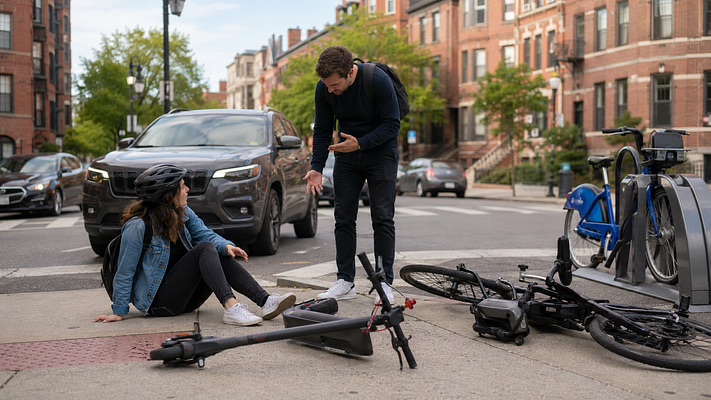
This is where e-bike and e-scooter riders are most often caught off guard, because these devices usually carry no insurance policy of their own.
If a Car Hit You
Massachusetts is a no-fault state. Personal Injury Protection, or PIP, pays up to $8,000 for medical expenses and a portion of lost wages regardless of who was at fault. A pedestrian or cyclist struck by a motor vehicle is generally covered by that vehicle's PIP, and if you own a car, your own PIP and your uninsured or underinsured motorist coverage may also apply. That matters a great deal when the driver who hit you was uninsured or fled the scene. To bring a claim for pain and suffering against the at-fault driver, Massachusetts law under Chapter 231, Section 6D requires that your reasonable medical expenses exceed $2,000, or that your injury meets the serious injury threshold, which includes a fracture, permanent and serious disfigurement, or the loss of a body function such as sight or hearing.
If You Were Riding and Caused the Crash
If you were at fault, for example if you struck a pedestrian, there is usually no auto liability policy covering your personal e-bike or scooter. A homeowners or renters insurance policy may provide some liability coverage, but many policies exclude motorized devices, so coverage is not guaranteed. This gap is one of the largest and least understood risks of micromobility.
Rental Devices
Renting a Bluebike or a scooter does not automatically insure you. Whether you have coverage depends on the operator's insurance and the terms you agreed to when you unlocked the device, which frequently place the risk on the rider. Do not assume you are protected simply because you paid to rent.
E-bike and e-scooter crashes often lack the clear documentation that follows a typical car accident. There may be no exchange of insurance information, limited or no police reporting, and genuine confusion about which set of rules applied to the device. Evidence such as the device itself, GPS and trip data held by a rental company, video from nearby cameras, and the maintenance history of a shared bike can be decisive. Much of that evidence is controlled by companies and can be lost or overwritten quickly. Preserving it early, and identifying every responsible party and every available source of insurance, is where experienced representation makes the greatest difference.
The technology may be new, but your right to full compensation is not. Injured riders and pedestrians in Massachusetts may recover past and future medical expenses, lost wages and future earning capacity, compensation for pain and suffering, loss of enjoyment of life, property damage, and wrongful death damages under Massachusetts General Laws Chapter 229, Section 2 if a loved one did not survive. Massachusetts does not cap compensatory damages in most personal injury cases, which means the full extent of your losses can be pursued.
Most Massachusetts personal injury lawsuits must be filed within three years of the crash under Massachusetts General Laws Chapter 260, Section 2A, and claims involving a public entity can carry much shorter notice deadlines. Because these cases depend on scattered evidence and on identifying multiple possible insurers, acting quickly is essential. Kiley Law Group investigates every crash thoroughly, gathering police reports, witness statements, device and trip data, and medical records to build the strongest possible case.
Kiley Law Group has represented injured drivers, passengers, and pedestrians across Massachusetts and New Hampshire for more than 50 years and has recovered over $1 billion for more than 1,000 clients. We handle these cases on a contingency basis, which means you pay nothing unless we win.
Call 978-474-8670 today for a free consultation, or contact us online.
This article draws on Massachusetts law governing electric bicycles and motorized scooters under Massachusetts General Laws Chapter 90, no-fault insurance and the tort threshold (M.G.L. c. 231, Section 6D), comparative negligence (M.G.L. c. 231, Section 85), wrongful death (M.G.L. c. 229, Section 2), and the statute of limitations (M.G.L. c. 260, Section 2A), along with publicly available information about the Bluebikes system. This page is for informational purposes only and does not constitute legal advice. Consult a licensed Massachusetts attorney for advice specific to your situation.