Get Help Today! | 978.474.8670

After a crash, the two drivers often tell very different stories, and the insurance company usually chooses to believe its own policyholder. But your vehicle may hold an objective witness: a small electronic device that quietly recorded what actually happened in the seconds before impact. People call it the black box. Its formal name is the event data recorder, or EDR.
Nearly every modern passenger vehicle has one. It can capture how fast a vehicle was traveling, whether the driver hit the brakes, and whether the occupants were wearing seat belts, all in the moments before a collision. In the right case, that data can resolve a fault dispute that would otherwise come down to one person's word against another's.
This article explains what an event data recorder captures, what it does not, who is allowed to access it in Massachusetts, and why acting quickly to preserve it can make or break a claim.
Kiley Law Group has represented injured drivers, passengers, and pedestrians across Massachusetts and New Hampshire for more than 50 years and has recovered over $1 billion for our clients. If you were injured in a crash that also left your vehicle damaged, call 978-474-8670 for a free consultation.
The event data recorder is a small electronic component, usually built into the vehicle's airbag control module. It is not a running record of your daily driving. Instead, it continuously monitors the vehicle's systems and permanently saves a short snapshot of data when it senses a crash-level event, such as a sudden change in speed or the deployment of an airbag. Federal data show that the vast majority of modern passenger vehicles are equipped with one. By model year 2013, roughly 96 percent of new passenger cars and light vehicles already had event data recorders installed.
The federal regulation at 49 CFR Part 563 standardizes the information an event data recorder must capture when a vehicle is equipped with one. The rule does not require every vehicle to have an EDR, but it defines what the device must record when one is present.
The Data That Can Prove Fault
For equipped vehicles, an event data recorder typically records, in the seconds before a crash, the vehicle's speed, the throttle or accelerator position, whether the brakes were applied, and steering input. It also captures crash-event information such as the change in velocity, known as delta-V, the timing of airbag deployment, and whether the driver and front passenger were wearing seat belts. This is precisely the kind of objective information that can show a driver was speeding, prove that the other driver never braked, or corroborate your account of how the collision happened. Beginning with vehicles manufactured on or after September 1, 2027, a federal update will extend the pre-crash recording window from about 5 seconds to roughly 20 seconds, capturing even more of what led up to the crash.
What an EDR Does Not Capture
It is just as important to understand the limits. An event data recorder does not record audio, video, GPS location, driver identity, phone use, or conversations. It captures vehicle system data around a crash event, not a running log of where you go or what you say. Knowing those limits helps set realistic expectations about what the data can and cannot prove.
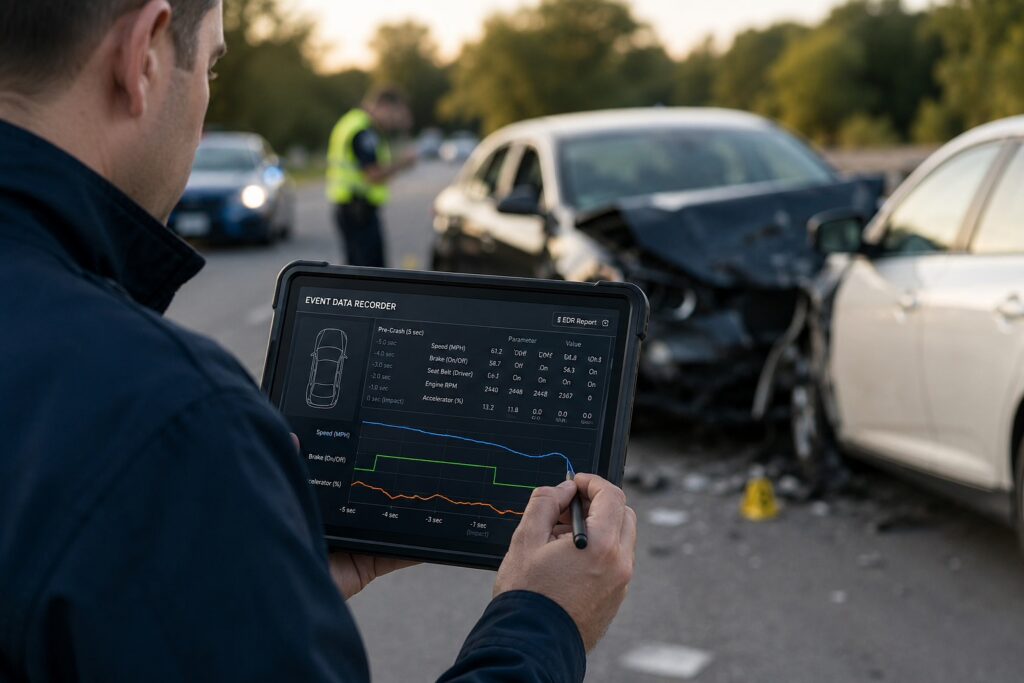
Event data recorder information is not automatically available to anyone who wants it. Under the federal Driver Privacy Act of 2015, the data recorded by an event data recorder belongs to the vehicle's owner or lessee, and it generally may not be accessed by others without the owner's consent, a court order or other legal authority, or a limited set of exceptions.
Massachusetts has not enacted its own event data recorder statute, so access in the Commonwealth is governed primarily by that federal law and the ordinary rules of civil discovery. In practice, that means the data is usually obtained with the owner's permission or through a formal legal request or court order during a claim or lawsuit. Retrieving it requires specialized equipment, most commonly a Crash Data Retrieval tool, operated by a trained technician who downloads and interprets the results.
Event data recorder information can be lost, and often quickly. After a crash, a damaged vehicle may be repaired, sold, or sent to a salvage yard and scrapped, and once that happens the data can become unavailable or be overwritten. If the key data sits in the other driver's vehicle, you may lose access to it entirely once their insurer takes control of the wreck.
This is why prompt action is so important. Massachusetts recognizes the doctrine of spoliation, which allows a court to impose sanctions when a party negligently or intentionally destroys evidence that it knew, or reasonably should have known, could be relevant to a case. Those sanctions can include instructing the jury that it may infer the lost evidence would have been unfavorable to the party responsible for destroying it. Sending a timely preservation demand and moving to secure the vehicle before it is repaired or scrapped can protect this evidence and your claim.
When fault is disputed, event data recorder information can be the difference between a denied claim and a full recovery. Insurance companies build their positions on statements, repair estimates, and their own adjusters' conclusions. Objective crash data is much harder to argue with. It can confirm speeds, show whether a driver braked or accelerated, and either support or contradict what a driver told the police or the insurer. Paired with accident-reconstruction analysis, the data helps establish exactly how a crash occurred and who is responsible. This kind of technical investigation is often what allows an injured person to overcome an insurer that is determined to shift the blame.
Because Massachusetts follows a modified comparative negligence rule under Massachusetts General Laws Chapter 231, Section 85, the percentage of fault assigned to each driver directly affects how much you can recover. Evidence that reduces or eliminates the blame placed on you can significantly increase the value of your claim.
If the other driver denies responsibility or the insurance company is blaming you, the evidence inside the vehicles may tell the real story, but only if it is preserved in time. Injured people in Massachusetts generally have three years to file a personal injury lawsuit under Massachusetts General Laws Chapter 260, Section 2A, but the window to secure physical evidence such as event data recorder information can be far shorter. Kiley Law Group investigates every crash thoroughly, gathering police reports, witness statements, crash and vehicle data, and medical records, and moving quickly to preserve the evidence that proves fault.
Kiley Law Group has represented injured drivers, passengers, and pedestrians across Massachusetts and New Hampshire for more than 50 years and has recovered over $1 billion for more than 1,000 clients. We handle car accident cases on a contingency basis, which means you pay nothing unless we win.
Call 978-474-8670 today for a free consultation, or contact us online.
This article draws on the federal event data recorder regulation (49 CFR Part 563), the federal Driver Privacy Act of 2015, Massachusetts law on comparative negligence (M.G.L. c. 231, Section 85) and the statute of limitations (M.G.L. c. 260, Section 2A), and the Massachusetts doctrine of spoliation of evidence. This page is for informational purposes only and does not constitute legal advice. Consult a licensed Massachusetts attorney for advice specific to your situation.