Get Help Today! | 978.474.8670
Driver-assist technology is no longer a novelty on Massachusetts roads. Adaptive cruise control, automatic emergency braking, lane-centering, Tesla Autopilot, and General Motors Super Cruise are already in everyday traffic across the state. When one of these systems is involved in a crash, the familiar question of whether the other driver was at fault suddenly becomes more complicated, because a computer may have been steering, braking, or accelerating at the moment of impact.
The confusion is understandable. If software was helping to drive, who is responsible when something goes wrong? The person in the driver's seat, the company that built the system, or someone else entirely? The answer depends on how much the vehicle was actually doing, what failed, and how Massachusetts law, most of which was written long before these systems existed, applies to the situation.
This article explains how liability and compensation work after a self-driving or driver-assist crash in Massachusetts. It covers the levels of driving automation, the state's current rules for these vehicles, who can be held responsible, and how the Commonwealth's no-fault insurance system fits in.
Kiley Law Group has represented injured drivers, passengers, and pedestrians across Massachusetts and New Hampshire for more than 50 years and has recovered over $1 billion for our clients. If you were injured in a crash involving a self-driving or driver-assist vehicle, call 978-474-8670 for a free consultation.
The Society of Automotive Engineers (SAE) defines six levels of driving automation, numbered 0 through 5, in a standard known as J3016. At Level 0, the human does all of the driving. At Level 1, the vehicle assists with a single task, such as adaptive cruise control. At Level 2, called partial automation, the vehicle can control steering and speed at the same time, but the human is still driving and must monitor the road at all times and be ready to take over instantly. At Level 3, conditional automation, the system can handle driving under limited conditions but must hand control back to the person when prompted. Levels 4 and 5 describe high and full automation that require no human input, and those vehicles are largely limited to testing programs.
This distinction matters because the level of automation largely determines who was actually in control of the vehicle, and therefore who may be responsible when a crash occurs. Almost every system marketed as self-driving on Massachusetts roads today is Level 2, including Tesla Autopilot, Tesla Full Self-Driving (Supervised), and GM Super Cruise.
Level 2 Is Where Most Massachusetts Cases Are Today
At Level 2, the person behind the wheel remains the legal operator of the vehicle even while the system is steering or braking. If a driver over-relied on the technology, became distracted, or failed to intervene when needed, that driver is generally responsible for the crash, just as in any other collision. Marketing names like Autopilot and Full Self-Driving can create a false impression that the car is fully autonomous, but under the SAE standard these are still driver-assist systems that require constant human supervision.
Unlike some states, Massachusetts has not enacted comprehensive legislation that specifically governs autonomous vehicles. Instead, testing and deployment are guided by Executive Order 572, signed by Governor Charlie Baker on October 20, 2016. That order created an Autonomous Vehicles Working Group and directed MassDOT to establish a process for permitting the testing of automated driving systems on public roads. Under that process, a company must submit an application, demonstrate that the vehicle has passed a Registry of Motor Vehicles inspection, and keep a human safety driver in the vehicle at all times while it is being tested.
Two companies, Optimus Ride and nuTonomy, which now operates as Motional, began testing in Massachusetts in 2017. The City of Boston also established its own framework and designated testing areas in the Seaport district. Because there is no state statute that specifically assigns fault for automated-vehicle crashes, these cases are resolved under existing Massachusetts negligence, product liability, and insurance law. At the federal level, the National Highway Traffic Safety Administration sets vehicle safety standards but has not enacted a comprehensive self-driving law either.
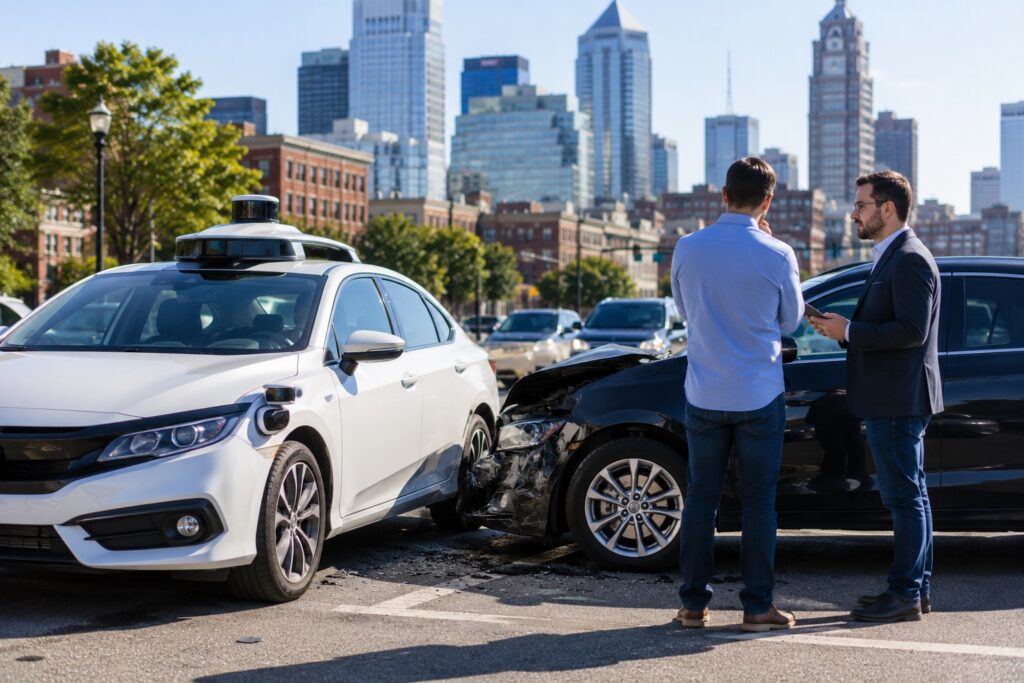
More than one party can share responsibility for a self-driving or driver-assist crash. Depending on what actually happened, any of the following may owe compensation to the people who were injured.
The Human Driver
In the large majority of crashes involving today's Level 2 systems, the person behind the wheel is responsible, because they were legally the one driving. Massachusetts fault rules apply in the same way they would in any car accident. Distracted driving, over-reliance on the automated system, and failure to take back control in time are among the most common causes of these collisions.
The Vehicle or Software Manufacturer
When a defect in the automated system, its sensors, or its software caused or contributed to a crash, the manufacturer may be liable. Massachusetts handles defective-product claims differently from most states. It does not recognize a separate strict liability tort. Instead, the implied warranty of merchantability under the state's version of the Uniform Commercial Code serves as the Commonwealth's form of strict liability, alongside ordinary negligence claims. In practical terms, a person injured by a defective vehicle or driving system in Massachusetts has recourse similar to that available in states with formal strict-liability claims. These claims turn on technical evidence and usually require expert analysis.
The Company Operating a Test or Driverless Vehicle
If a crash involves a vehicle that is being tested or operated by a company, that company may be responsible for the conduct of its safety driver or for the vehicle itself. Under Massachusetts law, an employer is generally liable for the negligence of an employee acting within the scope of employment. A permitted testing operator can also be held responsible for how the vehicle was maintained, monitored, and deployed on public roads.
More Than One Party at Once
These crashes often involve overlapping responsibility, such as a distracted safety driver combined with a sensor that failed to detect a hazard. Massachusetts law allows an injured person to pursue every party whose negligence contributed to the injuries. The state follows a modified comparative negligence rule under M.G.L. c. 231, Section 85. An injured person can recover compensation as long as they were not more than 50 percent at fault, and their compensation is reduced by their own share of the blame.
Massachusetts is a no-fault state. After most crashes, you first turn to your own Personal Injury Protection (PIP) coverage, which pays up to $8,000 for medical expenses, a portion of lost wages, and certain other costs, regardless of who was at fault. PIP pays the first $2,000 of medical bills, and beyond that amount your health insurer generally pays if you have coverage.
To step outside the no-fault system and bring a claim against an at-fault party for pain and suffering, Massachusetts law under M.G.L. c. 231, Section 6D requires that your reasonable medical expenses exceed $2,000 or that your injury meets the serious injury threshold. That threshold includes death, permanent and serious disfigurement, a fracture, or the loss of a body function such as sight or hearing. These insurance rules apply whether or not automation was involved in the crash.
Why These Cases Are Harder to Prove, and Why Evidence Matters
A self-driving or driver-assist crash usually hinges on data that an ordinary crash does not. Modern vehicles record information through event data recorders, and automated systems keep detailed logs of what the sensors detected, what the software decided, and whether and when the driver was warned or took control. This information can show whether the system malfunctioned, whether the driver was alerted, and who was actually controlling the car at the moment of impact.
That evidence can disappear quickly. Data can be overwritten, and manufacturers control access to proprietary software logs. Acting fast to preserve the vehicle and formally demand the data is often decisive. These cases also frequently require accident-reconstruction and software experts, which is one reason involving an attorney early is so important.
If You Were Injured in a Self-Driving or Driver-Assist Crash in Massachusetts
The technology may be new, but your right to full compensation is not. Injured people in Massachusetts may recover past and future medical expenses, lost wages and future earning capacity, compensation for pain and suffering, loss of enjoyment of life, property damage, and wrongful death damages if a loved one did not survive. Massachusetts does not cap compensatory damages in most personal injury cases, which means the full extent of your losses can be pursued.
Most Massachusetts personal injury lawsuits must be filed within three years of the crash under M.G.L. c. 260, Section 2A. If a claim involves a public entity, shorter notice deadlines can apply. Because these cases depend on evidence that can vanish and on parties with significant legal resources, acting quickly is essential. Kiley Law Group investigates every crash thoroughly, gathering police reports, witness statements, vehicle and software data, and medical records to build the strongest possible case.
Kiley Law Group has represented injured drivers, passengers, and pedestrians across Massachusetts and New Hampshire for more than 50 years. Attorney Tom Kiley has personally represented over 1,000 clients injured by the negligence of others. We handle car accident cases on a contingency basis, which means you pay nothing unless we win.
Call 978-474-8670 today for a free consultation, or contact us online.
This article draws on Massachusetts Executive Order 572 and MassDOT's framework for the safe testing of automated driving systems, the SAE J3016 standard that defines the levels of driving automation, and Massachusetts law governing no-fault insurance (M.G.L. c. 90 and c. 231, Section 6D), comparative negligence (M.G.L. c. 231, Section 85), the statute of limitations (M.G.L. c. 260, Section 2A), and product liability under the implied warranty of merchantability. This page is for informational purposes only and does not constitute legal advice. Consult a licensed Massachusetts attorney for advice specific to your situation.