Get Help Today! | 978.474.8670

A chain-reaction pileup is one of the most chaotic and dangerous events that can happen on a Massachusetts highway. One rear-end collision sets off a cascade of impacts. Vehicles pile into each other at highway speed. By the time the last car skids to a stop, there may be five, ten, or even fifty vehicles involved, multiple injuries, and a scene so scattered that reconstructing what happened takes weeks.
These crashes happen regularly on Massachusetts highways. I-93 through the O'Neill Tunnel and the Braintree Split. The Mass Pike through the Weston tolls and the Ludlow corridor. Route 128 through Woburn, Wakefield, and the North Shore. These are the state's highest-volume, highest-speed corridors, and when a chain reaction starts on any of them, the results are devastating.
The injuries in a multi-car pileup are often severe. But the legal aftermath can be just as overwhelming. When five or more drivers are involved, each with their own insurance company, figuring out who caused what and who pays whom becomes extraordinarily complicated. Insurance companies exploit that confusion. They delay, deny, and point fingers at other drivers to avoid paying their share.
If you were injured in a chain-reaction crash on a Massachusetts highway, Kiley Law Group can help. We have been handling complex multi-vehicle accident cases across Massachusetts and New Hampshire for over 50 years, recovering more than $1 billion for our clients. Call 978-474-8670 for a free consultation.
Multi-car pileups are not random. They follow patterns tied to specific road conditions, driver behavior, and the design of the highway itself. Understanding why they happen is the first step toward understanding who is at fault.
Interstate 93 is the busiest highway in Massachusetts, carrying approximately 200,000 vehicles per day through the Boston metropolitan area. The O'Neill Tunnel, where I-93 passes under downtown Boston, is a particularly dangerous stretch. Lane merges, limited sight distance, variable speed zones, and no shoulder create conditions where a single rear-end collision can cascade into a multi-vehicle pileup within seconds. In March 2024, a chain-reaction crash in the O'Neill Tunnel backed traffic up more than 10 miles to Stoneham after a pickup truck rear-ended another vehicle and triggered a series of collisions behind it.
North of Boston, the I-93/I-95 interchange in Woburn and the corridor through Medford and Stoneham consistently rank among the highest-crash locations in the state. In April 2025, a five-vehicle pileup on I-93 northbound in Medford killed one driver and shut down the highway for hours. The Braintree Split, where I-93 meets Route 3, is another notorious bottleneck where sudden speed changes trigger rear-end chain reactions during rush hour.
The Massachusetts Turnpike spans the entire width of the state, and its crash patterns vary by section. The eastern segment through Weston, Framingham, and Worcester sees heavy commuter volume that produces stop-and-go conditions at merge points. The western segment through Ludlow, Russell, and the Berkshires is more rural but features steeper grades, sharper curves, and heavy tractor-trailer traffic. In December 2024, a multi-vehicle crash involving tractor-trailers shut down the Mass Pike in Russell. In early 2026, two separate crashes involving four tractor-trailers closed a section in Ludlow and required a LifeFlight rescue.
Tractor-trailers are a recurring factor in Mass Pike pileups. A fully loaded truck at highway speed needs significantly more distance to stop than a passenger car. When a truck cannot stop in time, the force of impact pushes vehicles forward into the cars ahead of them, multiplying the number of vehicles involved and the severity of injuries.
Route 128 is the primary beltway around Boston's northern and western suburbs. The stretch between Woburn and Peabody, where Route 128 merges with I-95, is among the most congested and crash-prone corridors in the state. This section combines high speed limits, frequent on-ramp merges, and curves that reduce sight distance.
Winter weather amplifies the danger on Route 128. The highway's exposure to Atlantic weather systems means it ices over faster than inland roads. A freezing rain event caused a 30-car pileup on Route 128 in Wakefield that shut down the northbound lanes entirely, required dozens of tow trucks, and sent multiple people to the hospital. Smaller chain reactions of three to seven vehicles occur on Route 128 regularly during the winter months.
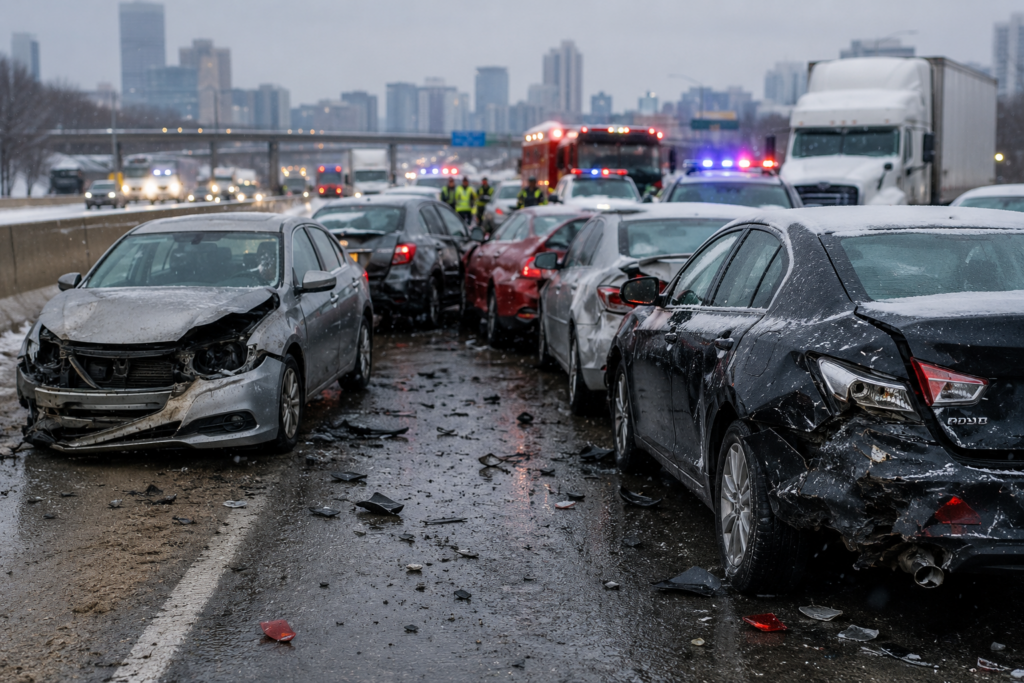
In a two-car rear-end collision, fault is usually straightforward: the driver who hit the car in front of them was following too closely or was not paying attention. In a chain-reaction pileup involving five, ten, or twenty vehicles, fault determination becomes far more complicated.
Investigators, insurance adjusters, and attorneys break a chain-reaction crash down into individual impacts. The first collision (Vehicle A hits Vehicle B) is analyzed on its own. Then the second collision (Vehicle C hits Vehicle A from behind, pushing it into Vehicle B again) is analyzed separately. Each impact may have a different at-fault driver, and each injured party may have claims against multiple drivers.
This is why accident reconstruction is so important in multi-car pileup cases. Physical evidence, including vehicle damage patterns, skid marks, gouge marks on the road surface, and the final resting positions of the vehicles, tells the story of which impacts happened in what order. Without a proper reconstruction, insurance companies will exploit the confusion to deny responsibility.
Massachusetts follows a modified comparative negligence rule under Mass. Gen. Laws Ch. 231, §85. This means fault can be divided among multiple parties. In a five-car pileup, the analysis might find that Driver 1 caused the initial crash by stopping suddenly, Driver 3 was following too closely and caused a secondary impact, and Driver 5 was distracted and hit the pileup at full speed. Each driver bears a percentage of fault for the injuries they caused.
The critical rule in Massachusetts is that you can recover compensation as long as you were not more than 50% at fault. If you are found 51% or more responsible, you are barred from recovering damages entirely. Your compensation is reduced by your percentage of fault. If your damages total $200,000 and you are found 20% at fault, you recover $160,000.
When multiple drivers share fault for your injuries, Massachusetts law allows you to pursue each at-fault driver's insurance policy separately. This is important because individual drivers may carry different levels of coverage. The minimum liability coverage in Massachusetts is $20,000 per person and $40,000 per accident, which is far too low to cover the medical bills from a serious pileup injury. If one at-fault driver carries only the minimum and another carries $250,000 in coverage, your attorney can pursue both policies to maximize your recovery.
Massachusetts is a no-fault auto insurance state, which means your own Personal Injury Protection (PIP) coverage pays your initial medical expenses regardless of who caused the crash. Every Massachusetts auto policy includes at least $8,000 in PIP coverage. PIP covers medical bills, lost wages (up to 75% of your earnings), and essential replacement services.
But $8,000 does not go far when you have been injured in a highway pileup. Ambulance transport alone can exceed $2,000. An emergency room visit with imaging commonly runs $5,000 to $15,000. Surgery, hospitalization, and rehabilitation can easily reach six figures.
To pursue a claim against the at-fault driver (or drivers) for your full damages, including pain and suffering, you must meet the "serious injury" threshold under Mass. Gen. Laws Ch. 231, §6D. You qualify if your reasonable medical expenses exceed $2,000, or if your injuries include a fracture, loss of hearing or sight, loss of a body member, permanent and serious disfigurement, or loss of an important bodily function.
In practice, most multi-car pileup injuries easily meet the $2,000 threshold. Broken bones, herniated discs, traumatic brain injuries, and internal organ damage are common in high-speed chain-reaction crashes. Once you meet the threshold, you can pursue a third-party claim against every at-fault driver involved in the pileup for the full value of your injuries.
This is where multi-car pileups differ most from standard two-car crashes. If three drivers contributed to your injuries, you may have three separate liability claims. Each claim is pursued against that driver's insurance policy. Your own uninsured/underinsured motorist (UM/UIM) coverage can provide additional compensation if any at-fault driver lacks adequate coverage. An experienced attorney will identify every available source of insurance and pursue them strategically to maximize your total recovery.
Insurance companies love multi-car pileups. Not because they want to pay out on them, but because the complexity gives them cover to delay and reduce payments. Here are the specific challenges you will face:
When five drivers are involved, five insurance companies are involved. Each one has a financial incentive to blame the other drivers and minimize its own insured's share of fault. This creates a circular blame game that can drag on for months or years while you are left paying medical bills out of pocket. Insurance companies know that the longer this process takes, the more likely you are to accept a lowball settlement just to make the financial pressure stop.
In the chaos of a pileup, drivers and witnesses often have conflicting accounts of what happened. One driver says they were pushed into the car ahead of them by a rear impact. Another driver says the first car was already stopped and they could not avoid it. Without physical evidence and expert reconstruction, these competing narratives make it easy for insurers to dispute liability.
If you were struck from behind and then pushed into the car ahead, you suffered two separate impacts. The insurance company for the rear driver will argue that your injuries came from the front impact, not the rear one. The insurance company for the front vehicle will argue the opposite. This injury-source dispute is a common tactic to avoid paying full compensation. Medical records, biomechanical analysis, and accident reconstruction evidence are essential to tying specific injuries to specific impacts.
Massachusetts minimum liability coverage of $20,000 per person is alarmingly low, and many drivers carry only the minimum. When a pileup involves multiple injured parties, the at-fault driver's policy limits are shared among all the victims. If a driver carrying $40,000 per accident injures three people, that $40,000 is split three ways. This makes UM/UIM coverage on your own policy critically important.
The outcome of a pileup case often depends on the quality and quantity of evidence gathered in the hours and days after the crash. Here is what matters most:
A highway pileup is an active, evolving scene. Additional vehicles may still be approaching at highway speed. Getting out of your car and standing on the highway is one of the most dangerous things you can do. If your vehicle is drivable, pull to the shoulder. If it is not, stay inside with your seatbelt on until emergency responders arrive.
A police report is essential. In a multi-car crash, you want officers documenting the scene, recording vehicle positions, and interviewing witnesses while memories are fresh. Massachusetts state police respond to all highway incidents on I-93, the Mass Pike, and Route 128.
If you are able, take photos and video of the scene from your vehicle or from a safe position off the highway. Capture the positions of all vehicles involved, damage to each vehicle, weather and road conditions, and any visible injuries. Get the names, phone numbers, and insurance information from every driver involved. Note the names and badge numbers of responding officers.
Even if you feel fine at the scene, go to the emergency room or urgent care the same day. Adrenaline masks pain. Concussions, herniated discs, and internal injuries may not produce symptoms for hours or days. Medical records starting the day of the crash establish a direct link between the pileup and your injuries.
In a multi-car pileup, you will hear from multiple insurance companies. Each one is looking for statements they can use to minimize their client's share of fault and maximize yours. You are not required to give a recorded statement to any insurer other than your own, and even with your own insurer, you should consult an attorney first.
Pileup cases involve multiple insurance policies, comparative fault across several drivers, potential trucking company liability, and time-sensitive evidence that must be preserved. This is not a case to handle on your own. An experienced attorney will preserve EDR data, obtain traffic camera footage, coordinate with accident reconstruction experts, and pursue every available insurance policy on your behalf.
If you were injured in a chain-reaction crash and were not more than 50% at fault, you may recover compensation for:
In cases involving grossly negligent behavior, such as a truck driver violating hours-of-service regulations or a driver under the influence of alcohol or drugs, additional compensation may be available. If the crash resulted in a fatality, surviving family members may pursue a wrongful death claim under Mass. Gen. Laws Ch. 229.
Massachusetts imposes a three-year statute of limitations for personal injury claims under Mass. Gen. Laws Ch. 260, §2A. You have three years from the date of the crash to file a lawsuit. Miss this deadline and you lose your right to compensation permanently.
In a multi-car pileup, three years is less time than it sounds. Accident reconstruction takes time. Medical treatment for serious injuries can last a year or more before the full scope of damages is known. Insurance negotiations with multiple carriers are slow by design. Starting the process early gives your attorney the time needed to build the strongest possible case.
Fault in a chain-reaction crash is determined by analyzing each impact separately. Multiple drivers can share fault. The driver who initiated the chain reaction typically bears primary responsibility, but any driver who was following too closely, speeding, or distracted may share liability for the impacts they caused. Massachusetts allows fault to be divided among all contributing parties under Mass. Gen. Laws Ch. 231, §85.
Yes, as long as you were not more than 50% at fault. Massachusetts follows a modified comparative negligence rule. Your compensation is reduced by your percentage of fault. If you are found 25% at fault and your damages are $200,000, you recover $150,000. If you are found 51% or more at fault, you cannot recover anything.
Every driver involved in the pileup has their own insurance company. If five vehicles are involved, there may be five separate liability policies, plus your own PIP and UM/UIM policies. In crashes involving commercial trucks, the trucking company's insurance adds another policy with potentially much higher limits. Your attorney pursues every available policy to maximize your recovery.
Yes. Massachusetts PIP coverage pays up to $8,000 for your medical expenses and lost wages regardless of who caused the crash. However, PIP does not cover pain and suffering, and $8,000 is rarely enough to cover the medical costs from a serious pileup injury. Once your medical expenses exceed $2,000, or if your injuries meet the serious injury threshold under Mass. Gen. Laws Ch. 231, §6D, you can pursue a full claim against the at-fault drivers.
Your own uninsured motorist (UM) coverage protects you if an at-fault driver has no insurance. Your underinsured motorist (UIM) coverage supplements your recovery if the at-fault driver's policy limits are too low to cover your damages. Massachusetts requires insurers to offer UM/UIM coverage to all policyholders. If you carry this coverage, it acts as a safety net when other drivers are inadequately insured.
Multi-car pileup cases are among the most complex personal injury claims. With multiple insurance companies, disputed fault, and serious injuries requiring extended treatment, resolution typically takes 12 to 24 months or longer. Cases involving accident reconstruction, depositions, or litigation take longer. Insurance companies deliberately slow the process to pressure you into accepting less. An experienced attorney keeps the case moving and ensures the delay does not cost you compensation.
Chain-reaction crashes on I-93, the Mass Pike, and Route 128 produce serious injuries and complicated insurance disputes. When five insurance companies are pointing fingers at each other, you need an attorney who knows how to cut through the noise and get you the compensation you deserve.
Kiley Law Group has handled complex multi-vehicle accident cases for over 50 years. We work with accident reconstruction experts, preserve critical evidence, and pursue every available insurance policy to maximize your recovery. We handle every case on a contingency basis, which means you pay nothing unless we win.
Call 978-474-8670 today for a free, no-obligation consultation.
This page is for general informational purposes only and does not constitute legal advice. Massachusetts law cited includes Mass. Gen. Laws Ch. 231, §85 (comparative negligence), Ch. 231, §6D (serious injury threshold), Ch. 260, §2A (statute of limitations), and Ch. 229 (wrongful death). Insurance minimums and PIP limits reflect current Massachusetts requirements. Crash statistics and incidents referenced are drawn from MassDOT data and published news reports. Laws change; consult a licensed Massachusetts attorney for advice specific to your situation.